By Princeley Njukang*
On October 12, 2025, Cameroonians will once again head to the polls to elect, possibly, the country’s next president. I use the word “possibly” deliberately. For 43 years, elections in Cameroon have followed a predictable script with the same ending.
Yet, even in this scripted reality, elections carry something vital, hope. Hope that promises made could become promises kept. Hope that change, however slim, remains possible.

But not all Cameroonians are permitted to be part of that hope. I am talking about the more than 3.48 million citizens with disabilities who have been pushed to the margins of our political life for decades.
This year is no different. Out of the twelve presidential candidates approved by the Constitutional Council, not one has articulated a vision for our inclusion. Not one manifesto mentions the rights, needs, or aspirations of persons with disabilities. We are treated as if we are invisible, a people without political rights or direction.
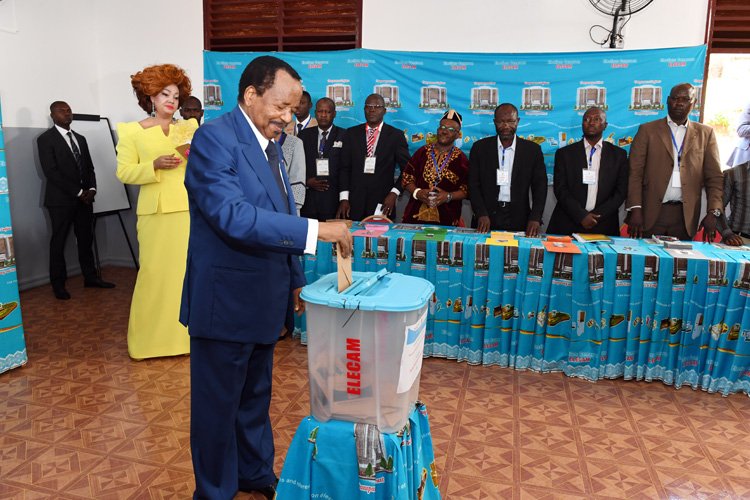
The numbers make this exclusion undeniable. According to ELECAM, only 33,985 voters with disabilities are registered, out of a potential electorate of over one million. That is just about three percent.
The remaining 97 percent of eligible voters with disabilities will stay outside the electoral process, not because they do not want to vote, but because they cannot. According to a study on political participation conducted by Sightsavers in 2022, people with disabilities are 1.5 times more likely not to have a birth certificate, twice as likely not to possess a national ID card, and 1.5 times more likely not to have a voter’s card compared to people without disabilities.
They are also 1.5 times more likely never to have voted. These are structural barriers, not a lack of interest. Our participation is unequal and undignified, the kind where I have to get to a polling station and have an untrusted individual read the content of ballot papers for me at the cost of being misled, as if the Electoral Code was foolish to make voting a secret act.
The kind where, as a person with hearing impairment, I can get to a polling station and receive the treatment of a madman because no one understands whatever I am doing with my hands.
There is also the risk of a situation where a mobility impaired person can be carried like a thing without respect into a polling station. Political participation and inclusion, for us, remains a party where we are called to strip naked, a game of humiliations.
Government officials admit this. In June, the Minister of Social Affairs, Pauline Irène Nguene, said: “Our democracy cannot be complete when millions of citizens remain on the margins of decision-making processes. Nothing for us without us” But if this is truly believed, why do we remain locked out? Why do the barriers grow taller with every election cycle?
The problem is not a lack of laws. Cameroon ratified the Convention on the Rights of Persons with Disabilities (CRPD) in 2021. Article 29 of that treaty obliges states to ensure the full and equal participation of persons with disabilities in political and public life.
Nationally, Law no. 2010/002 on the Protection and Promotion of Persons with Disabilities also affirms the same right. But here, laws are often written to be shelved. We are good at making commitments, cursed at implementing them.
This exclusion is not abstract. I have lived it. The 2018 presidential election was the first election hat I followed with rapt attention. A year before that, I had been bundled into the school bus of a Government Secondary School here in Buea, where I went to seek admission, and sent home.
The principal of the school told me that her school could not admit blind people, that they could not take the risk of having me contaminate young and bright leaders of tomorrow with my blindness.
So in 2018, I watched the campaigns, hoping at least one candidate would touch on issues affecting persons with disabilities. None dared. You can argue that our plights were subsumed into their social plans, but three million people do not get to be reduced into that argument, unless they are not full humans.
Today, as a journalist, a registered voter, and still a blind Cameroonian, I find myself asking the same questions: why are we still invisible? Why are we still too insignificant to earn even a single line in their manifestos?
For persons with disabilities in conflict-hit regions like the North West and South west, the barriers are even harsher. Displacement, armed violence, and humanitarian neglect combine to make political participation nearly impossible. As Human Rights Watch has documented, many disabled people in these regions cannot even access basic services, let alone exercise the right to vote.
The result is a democracy hollowed out by selective inclusion. Elections that silence 14 percent of the population. They are rituals of exclusion. And when political manifestos erase us, it signals that budgets, policies, and priorities will continue to erase us too.
But this does not have to be the case. Practical steps exist. Polling stations can be made accessible. Voter education materials can be produced in Braille, audio, and sign language. Electoral staff can be trained to provide dignified assistance.
Mobile or home voting options can be introduced for those unable to travel. Ensuring access to birth certificates, national IDs, and voter cards is foundational, according to the Sightsavers study, and would dramatically improve participation. These are not luxuries. They are basic measures, already practiced elsewhere, that would make participation real.
What is missing is not knowledge but will. Political parties must treat persons with disabilities as full citizens, not as an afterthought. Civil society and the media must stop staying silent and start demanding accountability. And the state must finally translate its words, Article 29, Law 2010/002, ministerial speeches, into lived realities.
Elections are more than the choice of leaders. They are a test of whose voices matter. On October 12, Cameroon will be tested. If we continue down this path, three million citizens will remain outside the gates of democracy, forced to watch as others decide their future.
Inclusion is not charity. It is justice. Until it is recognized as such, our elections will remain what they too often have been: promises unfulfilled, voices unheard, and hopes denied.
*Njukang Princeley is a freelance journalist with visual impairment based in Buea, Cameroon. He also edits Disability News Africa, a pioneering platform that champions inclusion and empowerment by challenging stereotypes and telling authentic stories of Africans with disabilities. He can be reached at njukangprinceley@gmail.com or via phone/WhatsApp at +237 678 520 457.
DISCLAIMER: Views expressed are solely those of the author and do not necessarily reflect NewsWatch’s editorial stance.