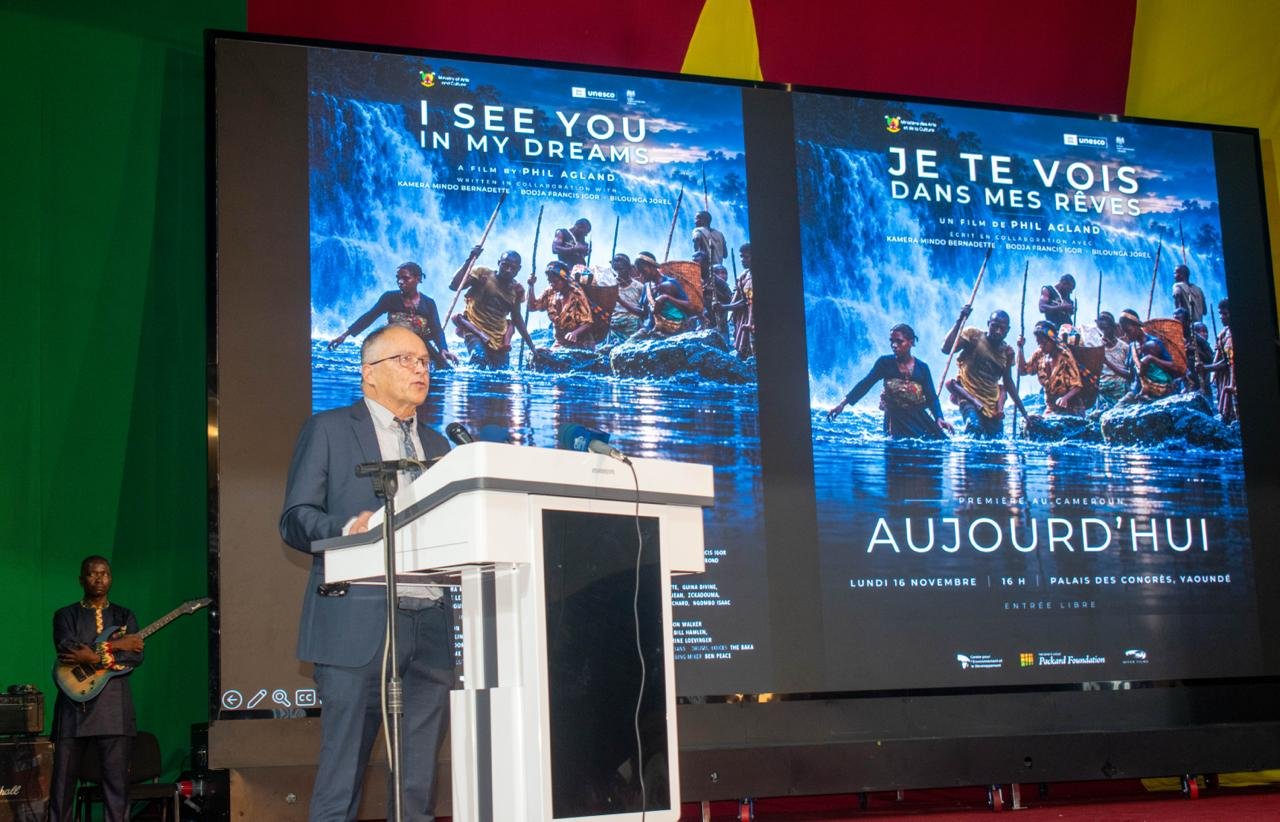
British filmmaker Phil Agland has spent more than 40 years documenting the lives of a Baka family in the rainforests of eastern Cameroon. His latest documentary, “I See You in My Dreams”, chronicles the family’s journey across several generations while highlighting the threats to Baka culture, identity and traditional way of life.
Co-produced with the Centre for Environment and Development (CED) in Cameroon and Dr. Samuel Nguiffo, the film explores the impact of deforestation, logging, mining and changing social relations on indigenous forest communities.
In this exclusive interview with NewsWatch Editor-in-Chief, Ndi Eugene Ndi, Agland reflects on his filmmaking journey, the plight of the hunter-gatherers and the importance of preserving their knowledge and cultural heritage.

Below is the Q&A interview, edited for length and clarity.
Read on…
NewsWatch: Could you tell us about your filmmaking journey and what brought you to Cameroon?
Phil Agland: I was not formally trained as a filmmaker. My passion was to come to Central Africa and help create national parks in the rainforest for local people. I arrived in Douala in January 1977, intending to work in the Korup Forest Reserve in Ndian Division, before there was even a road to Mundemba. We had to travel by small boat through the mangroves.
It took me five years to make my first film, during which I learned how to engage audiences through storytelling, particularly in natural history. Following its success, we raised funds to create the national park and persuaded the government to gazette it in 1986.
I subsequently made natural history films around the world, but felt something was missing: people. I wanted international audiences to see the forest through the eyes of those who knew it best. That creates empathy because it is people relating to people. The obvious people were the Baka. So, in 1984, I returned to Cameroon to spend two years in a Baka village in the rainforest.
NewsWatch: How did you eventually find the Baka family whose story you have followed for decades?
Phil Agland: Documentary filmmaking requires audiences to connect with the people on screen. They want to know their faces, personalities and stories. I travelled through Sangmelima, Djoum and Moloundou, visiting hundreds of Baka villages. We had probably covered 3,000 kilometres but still had not found the right family. Just before Christmas, when we were almost losing hope, we heard about a village deep in the forest where the Baka chief wanted independence. He wanted to live inside the forest rather than beside the road.
“When the Baka are separated from the forest, their entire sense of identity disappears. They lose everything, really.”
That was where we found our family. They were incredibly charismatic. Forty years later, we are still following them. Some have died, while babies whose births I filmed are now 40 or 45 years old. We have witnessed several generations.
The objective has always been to draw audiences into what might initially seem like an unfamiliar world, make it understandable and reveal the universal connections between human beings.
NewsWatch: In finding stories that reveal personality as you said earlier, what did you discover about the Baka that surprised or troubled you?
Phil Agland: It didn’t really trouble me. What I wanted was the original life of the Baka. Villages beside roads were already changing under the influence of the modern world. I wanted to find a traditional village.
I would ask a simple question: When did Jengi, their forest spirit, last visit you? If it had been more than five years, that was too long. In village after village, people could not remember. Eventually, we found two or three communities where the tradition was still alive. But even in the 1980s, the changes were already visible.
The Baka have an extraordinarily long history in the forest. Their traditional knowledge has been developed and refined over countless generations. My initial objective was rainforest conservation, but it quickly became about respecting a people whose knowledge represents an invaluable heritage.
NewsWatch: Your film shows how forests are increasingly being lost to logging and mining companies. Beyond the loss of trees, what else is disappearing from the lives of the Baka?
Phil Agland: I think the truth is uncomfortable. The truth is the relationship between Bantu people, farmers and the Baka. There has historically been a relationship of dependency and exploitation, with farmers treating the Baka as though they own them. Even today, you sometimes hear people refer to them as “my Pygmies”. They ask, “Why are you filming my Pygmies?” That is at the heart of the problem today in the modern world.
The Baka have limited access to money and depend largely on their knowledge of the forest for medicines, food and other necessities. Their farming neighbours often become gatekeepers to the modern economy. This unequal relationship has reinforced a sense of ownership and exploitation.
The Baka are also physically smaller than many of their neighbours, which makes the relationship intimidating. The problem is not simply the destruction of their forest habitat. It is also the social and economic structures that undermine their independence and dignity.
NewsWatch: Why have you chosen to make the Baka family central to your documentaries rather than relying on conventional filmmaking fixers and intermediaries?
Phil Agland: I have made five films about this family. The first was broadcast internationally in 168 countries in 1987 and 1988. I subsequently made two more films before returning in 2010 to document what had happened to them for the BBC. Throughout the decades, I have maintained a relationship between the audience and this single family. Viewers have watched the children grow up, witnessed births and followed the challenges they have faced.
For instance, the woman whose voice you hear in the latest film was born in 1986. I filmed her birth when she was tiny, with hands the size of my thumb. She is now 40 and provides the voice for the new documentary. This film is essentially the journey of a family across the last 40 to 50 years.
NewsWatch: Is it possible to integrate indigenous communities into development without destroying their cultural identity and knowledge?
Phil Agland: Absolutely, but it requires recognising the value of their knowledge. Baka knowledge has been refined over thousands of years and has a significant contribution to make to rainforest management in southern Cameroon and throughout the Congo Basin.
They understand the chemistry of trees, which they use for medicines. They understand animal behaviour and the relationships between plants and animals. This knowledge is an important part of Cameroon’s cultural heritage and should also be considered an asset for the country’s future.
NewsWatch: But can the Baka integrate into modern society?
Phil Agland: It is very difficult. For the Baka, leaving the forest is like coming out into the sunlight. They have no established connection with the modern world. Traditionally, they have been an egalitarian people without chiefs, living in a society that is very different from the often aggressive and hierarchical modern world.
The choice must be theirs. The forest is where they feel most comfortable. It gives them their sense of identity and empowerment.
“Baka knowledge has been refined over thousands of years and has a significant contribution to make to rainforest management in Cameroon and throughout the Congo Basin.”
Consider what happens when someone loses the very thing that defines them. I asked the composer of the film’s music: “If music becomes illegal, who are you?” He replied that he would be nothing. That is what happens when the Baka are separated from the forest.
Outside the forest, alcohol has also become a means of exchange because they have little access to money. Some farmers exploit this vulnerability by paying them in whisky. However, I do not believe alcohol is necessarily an addiction for them. During the months I have spent with them in the forest, alcohol has not been an issue. It is largely associated with their difficult interaction with the outside world. Education can help, but cultural diversity must remain central to Cameroon’s future. The Baka have an important role to play in the country’s multicultural heritage.
NewsWatch: Beyond the empathy you talked about earlier, what concrete change do you hope this documentary will trigger, particularly within the Cameroonian government, regarding the protection of the Baka and their environment?
Phil Agland: I want the documentary to be inclusive. I want it to be Cameroonian because we are all part of this. There are no simple solutions, and the film is not about pointing fingers or blaming particular people.
The modern world has created this dilemma. The documentary confronts difficult issues, including child rape, alcohol manipulation and exploitation. But it also offers hope: the possibility of cultural resurrection after what seems almost like the end of Baka culture.
There is still time. Four, five or six years. There is still time to allow the new green shoots of Baka culture to emerge again.
NewsWatch: After more than 40 years of interacting with the Baka, what has this journey taught you about the relationship between humans and nature given that these people live very close to nature?
Phil Agland: It is about respect and knowledge. But we must remember that the Baka also hunt animals, including antelopes and monkeys, for food. Their relationship with nature is practical, not simply one of reverence.
The future of forests must have a human dimension. We cannot pretend that forests should remain untouched. We must find better ways of managing them while ensuring that wildlife continues to thrive.
For example, when harvesting wild yams, the Baka take only half and replant the other half for future generations. That is practical forest management. We must be intelligent and broad-minded about conservation rather than treating forests as spaces reserved exclusively for national parks, with no place for people.
NewsWatch: Your film suggests that when the forest disappears, the Baka lose much more than their habitat. They lose their identity. Do you agree?
Phil Agland: That is the key issue. We all build our identities around what we do and where we belong. I am a filmmaker; that gives me confidence and defines who I am. You are a journalist and that is your identity. If you are no longer a journalist because it becomes illegal to write, what do you become? Who are you?
For the Baka, the forest is central to their identity. Without it, that entire sense of self identity disappears. They lose everything, really, and becoming people living on the margins of modern life. But we can draw from the example of John Lennon of the Beatles and his song Imagine. He imagined a world without possessions, leaders or wars. That is very close to the world the Baka have lived in for thousands of years. But today, that world is disappearing, and they are increasingly unable to cope with the pressures of modern society.