𝗕𝘆 𝗧𝗶𝗺𝗯𝘂𝗸𝘁𝘂 𝗜𝗻𝘀𝘁𝗶𝘁𝘂𝘁𝗲 – 𝗡𝗼𝘃𝗲𝗺𝗯𝗲𝗿 𝟮𝟬𝟮𝟱
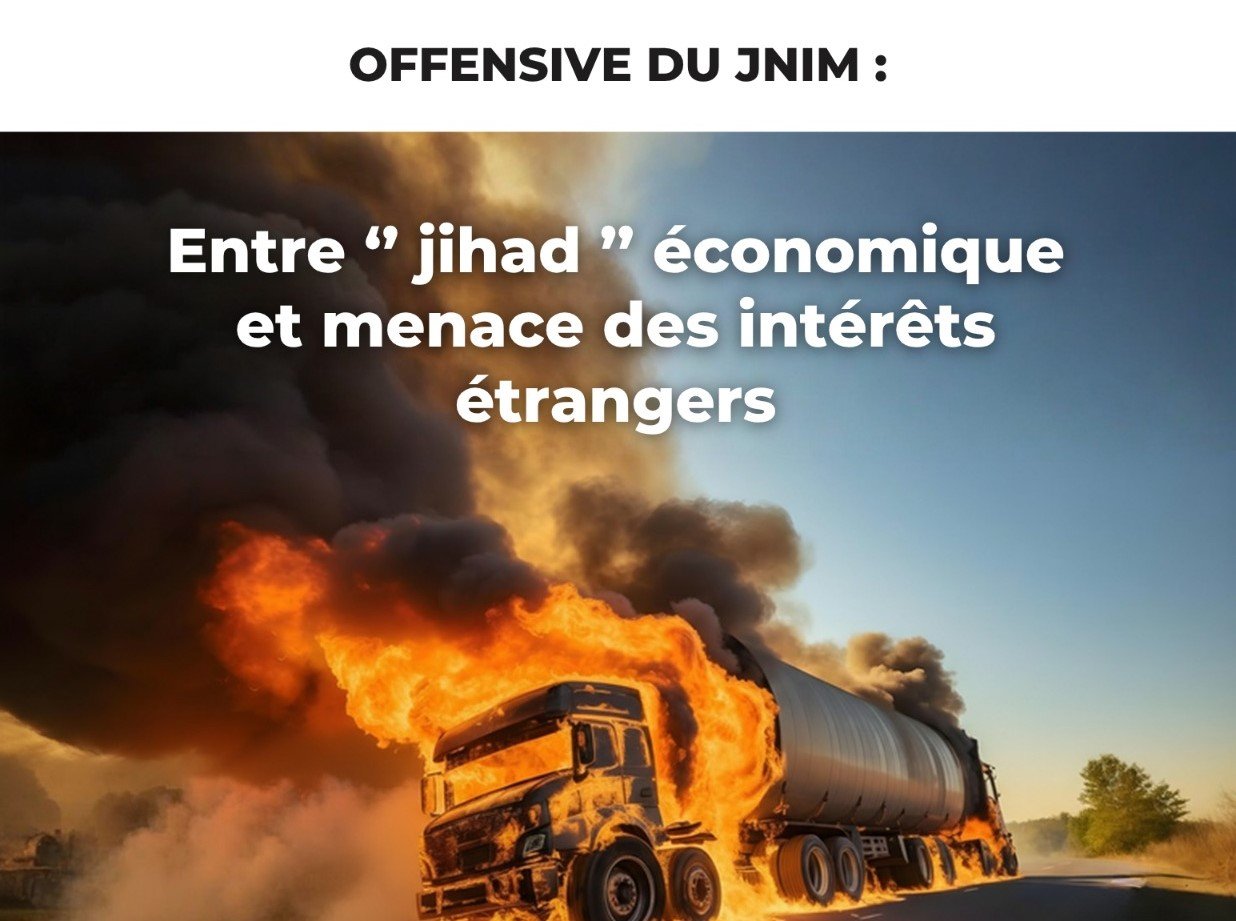
The recent kidnappings of foreigners and the substantial ransom of $50 to $70 million reportedly paid to the terrorist group Jamâ’at Nusrat al-Islâm wal Muslimîn (JNIM) to secure the release of two Emiratis and one Iranian have reignited questions about the security of investments and even the viability of economic sites in the Sahel region. This phenomenon certainly accentuates the effects of the economic suffocation strategy, but it also internationalizes the echo of an economic “jihad” that also seems to be part of an effort to weaken the military regimes in place. The offensive by JNIM in the central Sahel in 2025 is inflicting increasing economic damage on foreign interests, turning foreign investors and companies into strategic targets of a hybrid and endemic threat. In the heart of the unstable regions of Mali, Niger, and Burkina Faso (countries of the Alliance of Sahel States – AES), JNIM attacks are no longer limited to security forces: they now directly target economic infrastructure, mining sites, and logistics convoys, with the strategic objective of suffocating local economies and delegitimizing the regimes in place. In 2025, JNIM intensified its operations against foreign targets, demonstrating at the same time a growing ability to strike on several fronts simultaneously.
In the gold-rich region of Kayes, which accounts for around 80% of Mali’s gold mines and is a vital trade corridor to Senegal, several raids have been carried out. On July 1, three Indian nationals were kidnapped from the Diamond Cement Factory, prompting an immediate response from the Indian Ministry of Foreign Affairs. Between late July and August, six Chinese industrial sites, mainly gold mines, were attacked, resulting in the kidnapping of Chinese citizens. Beijing is said to have demanded that the Malian authorities urgently strengthen security for projects in this area. On August 22, the Bougouni lithium mine in Mali, operated by the British company Kodal Minerals, was targeted, killing a security guard and forcing a tightening of security measures. This escalation reflects a sophisticated strategy: beyond direct attacks on industrial sites, JNIM disrupts logistics chains through blockades and ambushes on convoys, compromising the exploitation of strategic resources such as gold, uranium, and lithium. Such actions affect all foreign investors—Chinese, Western, Indian, Russian—regardless of their origin, despite the diplomatic shift of AES regimes toward non-Western partners (China, Russia, Turkey).

This repositioning has not secured the economic sites where the new partners operate, exacerbating the persistent vulnerability of extractive and infrastructure projects. The economic impacts are multiple and interconnected. In the short term, operational disruptions lead to production stoppages, additional security costs, and direct losses of resources. In the longer term, insecurity risks creating a major deterrent effect: foreign companies are reluctant to maintain or increase their investments in high-risk areas, threatening a drastic drop in foreign direct investment (FDI) flows. The key exports of AES countries—notably gold and uranium, which account for a significant share of their revenues—are directly affected, weakening their trade balances and their ability to finance development and even infrastructure. At the same time, JNIM skillfully exploits local grievances by labeling foreign investors as “economic colonizers” and accusing their projects of exploiting resources without benefiting the local population. This rhetoric, amplified by the terrorist group’s propaganda, strengthens its community roots, while delegitimizing the alliances of AES regimes and their new partners, who seem unable to meet the security challenge.
It is true that security partnerships, particularly with Russian mercenaries, are increasingly criticized for their inefficiency and abuses, while China’s presence, despite being massive through the Belt and Road Initiative, is increasingly challenged by local economic actors. Beyond human (kidnappings, deaths) and material losses, the strategic consequences are serious: increased risk of insecurity spreading to coastal countries (Senegal, Benin, Togo), threats to regional trade corridors, and erosion of the soft power of foreign investors. Faced with this hybrid threat, companies must necessarily adapt their strategies: strengthening security coordination with the AES while investing more in community projects (education, water, health) to counter the JNIM’s exploitation of local frustrations. Ultimately, the JNIM offensive is not only targeting foreign interests as such, but is using them as leverage to strangle the economies of the AES, weaken the regimes in place, and consolidate its territorial hold. Without a coordinated and sustained response, this dynamics risks triggering massive disinvestment, regional economic contraction, and increased instability, with lasting repercussions for stability in the Sahel and beyond.
The note published on November 4, 2025, by the Timbuktu Institute first examines the JNIM’s targeted escalation against foreign interests through a review of attacks in 2025 and an analysis of their strategic evolution. It then explores the group’s underlying motivations, between symbols of interference and the economic suffocation of AES regimes. Finally, the last section analyzes more specifically the multiple consequences—human, economic, and strategic—of this hybrid threat, before suggesting ways for foreign investors to adapt in a context of lasting instability in the Sahel.