The National Disarmament, Demobilisation and Reintegration Committee (NDDRC), in collaboration with key national and international partners, has intensified efforts to consolidate peace in Cameroon by developing an action plan for the implementation of the National DDR Strategy adopted in 2025.
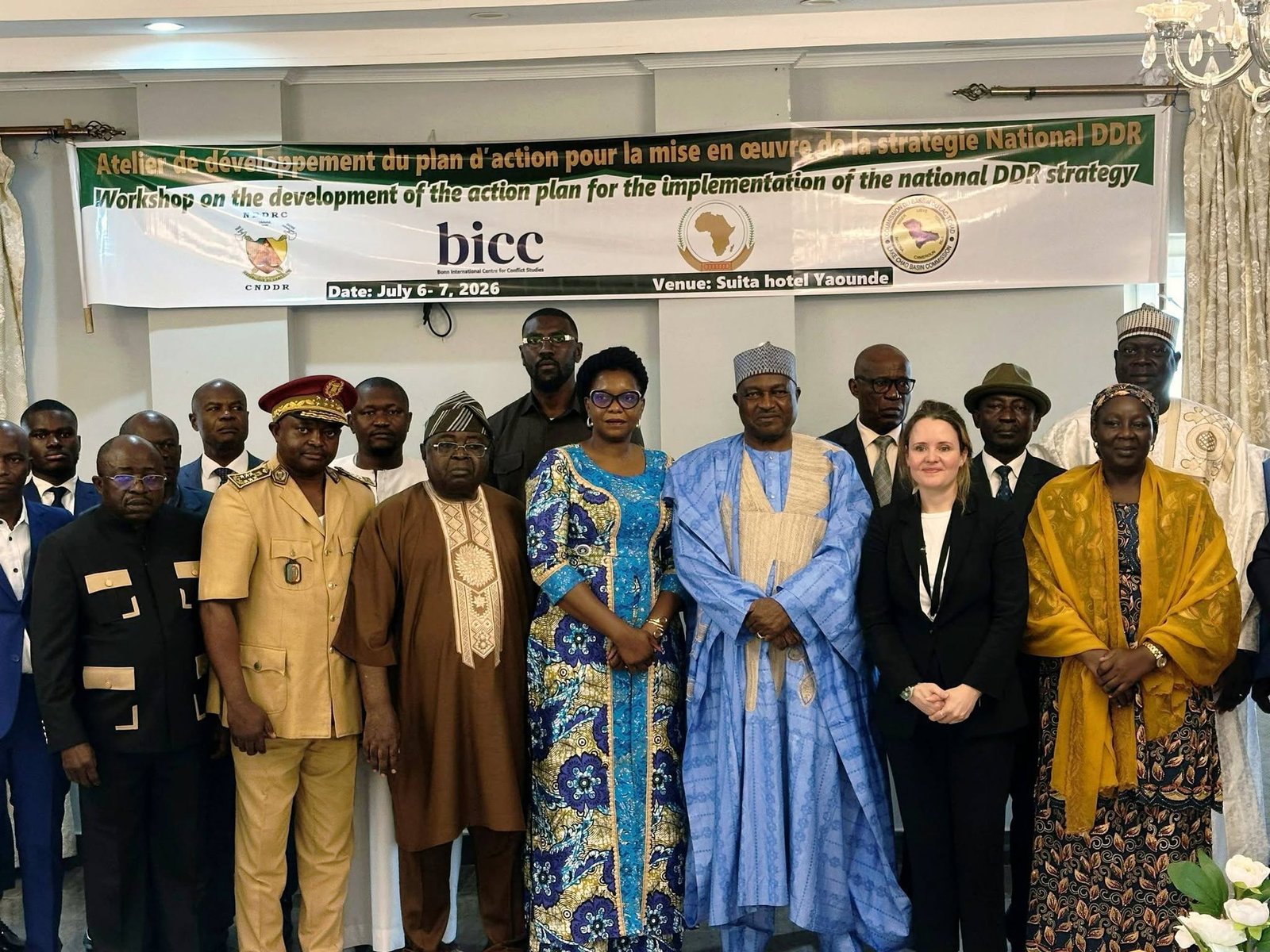
The two-day workshop, held in Yaounde from July 6 to 7, 2026, brought together coordinators of the DDR regional centres in Maroua, Bamenda and Buea, alongside representatives of the Lake Chad Basin Commission (LCBC), the Bonn International Centre for Conflict Studies (BICC), and other stakeholders.
Launching the workshop, the National Coordinator of the NDDRC, Fai Yengo Francis, described the meeting as a continuation of a process that began in December 2025 with the technical validation of the National DDR Strategy.

“The workshop that we are having today, which is centered mostly on the action plans proposed by the regions, is part of a journey which we started in December last year, when, together with the help of our partners, we decided to technically adopt the national DDR plan,” Fai Yengo said.
He explained that the security situations in the North West and South West regions, as well as the Boko Haram insurgency in the Far North, present distinct challenges that require tailored responses.
“The situation on the ground is not similar in every region. So we think that they will come out with the special things in their regions, with the specificities, and at the end of this, it shall now align with the national strategy of the DDR, which is the set of rules and regulations that guide the DDR process,” he said.
Fai Yengo also highlighted the committee’s progress, revealing that 3,772 ex-combatants are currently undergoing the DDR process at the three regional centres. Yet the committee’s most significant achievement, according to the Coordinator, is its first large-scale reintegration exercise conducted in the Far North in 2024, during which 708 former associates of armed groups—including many women and children—were successfully reintegrated into their communities.
Representing BICC, Senior Adviser Milena Berks commended the Government of Cameroon for its sustained commitment to the peace process and reaffirmed her organisation’s support for the NDDRC.
She explained that BICC is implementing a joint project with the African Union, the Lake Chad Basin Commission and the United Nations Peacebuilding Support Office to prevent recruitment into armed groups while facilitating the disengagement and reintegration of former fighters.
“It is in this context that we had the pleasure of cooperating with the National DDR Committee on developing the National DDR Strategy, which was technically validated in December last year as a milestone achievement,” Berks said.
Speaking on behalf of the Lake Chad Basin Commission, Mimsta Marthe called for stronger regional collaboration to address the persistent security challenges affecting the Lake Chad Basin.
She praised both the Government of Cameroon and the NDDRC for adopting an inclusive approach that actively involves public institutions, local authorities, civil society organisations, women, youth and community leaders.
“Regional experience teaches us that the success of such a process depends heavily on the level of ownership by the communities themselves, as well as their capacity to sustainably support the reintegration of ex-associates in a climate of trust, dialogue and reconciliation,” she said.
The workshop came just days after the conclusion of a five-day training programme on weapons and ammunition management organised by the Ministry of External Relations and its partners, underscoring Cameroon’s broader efforts to strengthen peacebuilding, security and post-conflict recovery.