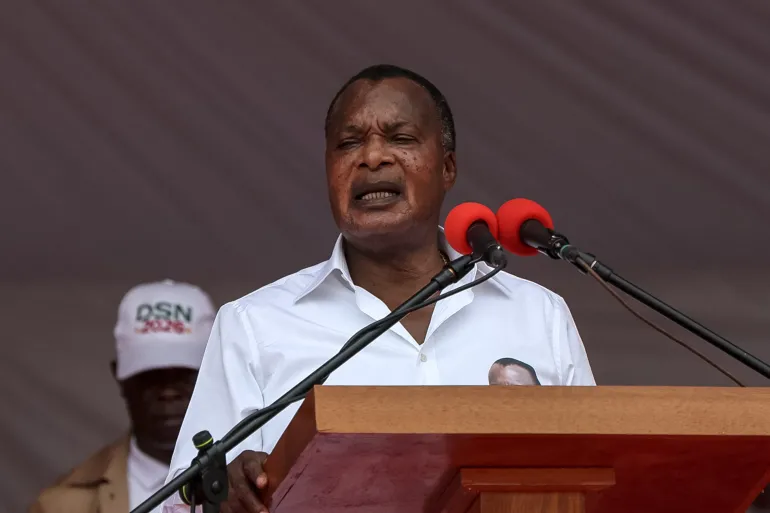
Voters in the Republic of the Congo headed to the polls on Sunday, March 15, to elect a new president as 82-year-old incumbent Denis Sassou Nguesso seeks to extend his more than four decades in power in the oil-rich Central African country.
Congo is the latest member of the six-nation Central African Economic and Monetary Community (CEMAC) to hold presidential elections over the past 22 months — most of which have been won by incumbents. From the forests of Cameroon to the oil fields of Gabon, from the landlocked plains of Chad and the Central African Republic to the island nation of Equatorial Guinea, each member state has, at different moments and on its own terms, presented citizens with a ballot.
Chad opened the electoral cycle in the subregion with the election of Mahamat Idriss Déby Itno in May 2024. In November of the same year, Teodoro Obiang Nguema Mbasogo — Africa’s longest-serving leader — was re-elected president of Equatorial Guinea.

In Gabon, Brice Clotaire Oligui Nguema, who led the coup that ended the Bongo dynasty, was elected president in April 2025. In October of the same year, Paul Biya — the world’s oldest serving president — was again re-elected for a seven-year term in a disputed poll in Cameroon.
Earlier this year, Faustin‑Archange Touadéra secured a third term in the Central African Republic in January 2026 following a controversial 2023 constitutional change that removed presidential term limits.
The Republic of Congo, the last in the bloc to vote, has now brought that collective electoral journey to a close — a process many observers describe as largely peaceful, though critics debate whether this stability reflects political maturity or political repression.
Often overshadowed in global headlines by its larger neighbour, the Democratic Republic of the Congo, across the Congo River, the Republic of Congo has long navigated a complex political landscape. Sassou Nguesso is among Africa’s longest-serving leaders, presiding over an oil-rich nation that has struggled to translate its natural wealth into broad-based economic development.
As in other CEMAC states, election day unfolded under cautious hope — a sentiment tempered by years of institutional familiarity, economic frustration and a political culture that has historically offered limited space for genuine electoral contestation.
Still, Congolese citizens turned out to vote. They queued at polling stations, cast their ballots and now await the outcome — even as many expect a familiar face to remain at the helm for another five-year term.
The CEMAC electoral cycle
Elections across CEMAC paint a nuanced portrait of a region at a political crossroads. In some member states, incumbents consolidated power with commanding margins. In others, opposition voices grew louder and civil society became more assertive — though such momentum has often faded quickly.
In certain cases, dynastic succession has also been presented as political renewal. Across the bloc, questions surrounding electoral integrity, voter participation and institutional credibility remain central to political discourse.
This reflects a broader paradox of democratic practice in much of Central Africa: elections are regularly held, but the depth of democratic accountability remains widely debated. The ballot box exists — yet whether its outcomes truly reflect the will of the people continues to be contested.
Regional bodies such as CEMAC and the larger Economic Community of Central African States (ECCAS) have deployed election observation missions and issued statements following the polls. However, analysts argue that deeper structural reforms — particularly around electoral commission independence and judicial oversight of results — remain necessary across the bloc.
Sassou Nguesso officially announced his candidacy on February 5, 2026, framing his campaign around infrastructure modernization, economic recovery and preparing the country’s youth to “take the relay.”
His candidacy follows a 2015 constitutional amendment that removed the two-term presidential limit and the 70-year age cap, changes that allowed him to contest elections beyond the previous constitutional restrictions, according to the Africa Center for Strategic Studies.
With The Republic of Congo now drawing the curtain on CEMAC’s electoral cycle, the more pressing question for citizens across the region — from Yaoundé to Libreville, Bangui to N’Djamena, Malabo to Brazzaville — is whether these elections will translate into tangible improvements in daily life.
For many voters though, the sentiment remains familiar: “We voted. Now we wait. That is what we always do.”