The government has announced a raft of ongoing mining reforms that could see the country’s mining sector generate over FCFA 1,000 billion in state revenue annually in the short term.
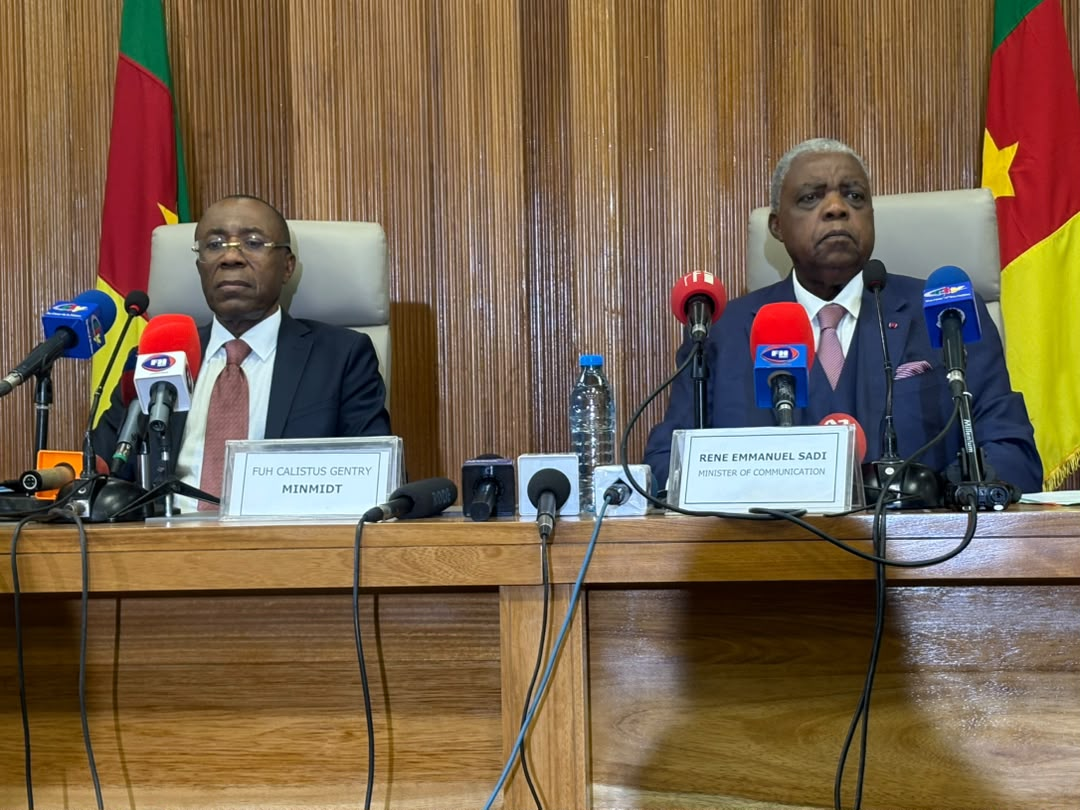
Addressing the press in Yaounde on Wednesday, July 15, the Minister of Communication and Government Spokesperson, Rene Emmanuel Sadi, and the acting Minister of Mines, Industry and Technological Development, Professor Fuh Calistus Gentry, said the expected industrial boom would potentially put the mining sector way ahead of the oil and gas sector, which contributes approximately FCFA 524 billion to the state revenue.
The first crucial step taken by the government to achieve this, Minister Fuh Calistus disclosed, entails restructuring the gold mining sector, first by assigning unique responsibilities to six key actors to ensure that all the revenues generated go to the state treasury.

While the Ministry of Mines acts as the policy regulator, the National Mining Corporation (SONAMINES) is the sole state entity authorized to collect gold and taxes in kind at the source. The Directorate General of Taxation delegates physical collections to SONAMINES, while the Directorate General of Customs monitors compliance at border exits. Supporting these efforts, the Security Forces secure mining sites and enforce illegal closures, while the Kimberley Process guarantees international traceability and compliance.
Another key reform is a monthly gold production threshold of a minimum of 5 kg per site.
”For it to be an economically acceptable activity, you must have a threshold to produce at least 5 kg, multiplied by 12 months; it will be 60 kg a year. That makes sense,” Minister Fuh Calistus Gentry explained.
Away from that, Cameroonian nationals must now hold a majority stake of at least 51% of the share capital in any semi-mechanized mining operation.
Furthermore, companies must pay a refundable environmental restoration bond of FCFA 63 million per site, as part of efforts to clean the environment.
Over 200 illegal semi-mechanized sites were identified, and the Ministry has already taken over 100 non-compliant companies to court and revoked dozens of exploration permits that were illegally acting as exploitation sites.
Also worth noting is a fiscal obligation, demanding strict adherence to a 25% simplified mining tax and a 5% export duty collected directly at the source.
These measures will solve a significant problem in the previous tax collection system identified by Minister Fuh Calistus Gentry
“Primary artisanal gold production takes place in two stages – an initial physical crushing stage that recovers less than 30% of the gold contained in the ore, followed by a chemical stage of cyanidation and leaching which recovers more than 90%,” he added.
Since the state’s previous collection system essentially only monitored the initial physical crushing phase, almost 80% of the gold produced was left undeclared, escaping taxation entirely. Operators exploited Cameroon’s self-assessment tax system to declare minimal figures far below actual production.
The state is not just giving instructions. After launching five mining projects in 2025, the government is looking ahead to 2026 and is actively developing five additional major projects: Mbalam, Nkout, Ngovayang (Mvayan), Bibemi, and a gold mine in Méiganga.
Revenue breakdown
Based on these reforms, the state is currently pursuing FCFA 95 billion in uncollected dues from identified leaching operations active during the 2025 financial year. Another FCFA 95 billion is expected to be recovered under the same reassessment measures for the first half of 2026.
Similarly, the government expects to collect approximately FCFA 5.8 billion from fines levied against the 137 non-compliant mining companies currently in court.
An additional FCFA 3.15 billion has been established from the 50 companies already aligned with the environmental guidelines (with FCFA 2.8 billion of that sum already actively collected).
“The revenue from these projects, together with the restructured gold sector, can be conservatively projected at more than FCFA 1,000 billion per year, well above the current contribution of the oil sector”, the minister noted, adding that Cameroon’s gold reserves stand at approximately 1500 kg.