By Leocadia Jisi, Guest Writer
Fifteen years ago, Peter Adebanwu’s parents left the Yoruba village of Illorin in Nigeria in search of a better life. They joined the fishing community in Yoyo II, about 245km from Cameroon’s capital, Yaounde.
Adebanwu, now 25, is a young fisherman eking a living from the waters of the Edea-Douala National Park in Yoyo II. He is one of the many foreigners – Nigerians, Ghanaians, Beninians, and others who make up the fishing community, alongside Cameroonians.

Initially absent from management and denied entry, the young fisherman and communities around protected areas did not influence the administration. However, this is now changing as they are increasingly seen as being essential to conservation. The establishment of local collaborative communities may be a solution to contribute to the protection of the park and the sustainable management of the natural resources.
Within the Programme for the Sustainable Management of Natural Resources, South West Region (PSMNR-SWR), the Ministry of Forestry and Wildlife produced a guidebook in 2024 titled ‘Guide to the involvement of local communities in the management of protected areas,’ with funding from the German Cooperation. According to the guidelines, local communities must be involved in the planning and decision-making process for protected area management.

It is against this backdrop that Environmental Justice Foundation (EJF) stepped in to support the government in putting in place Local Collaborative Management Committees (LCMCs), village-level bodies that give voice to marginalized groups (women, youth, and ethnic minorities) and ensure that their concerns are included in management plans. They help mediate between the community and the government, monitor illegal activities, and lead sustainable development initiatives.
According to Augustine Fayiah, EJF Programme officer for Liberia, through its global toolkit for participatory governance, the organisation provides technical guidance for practitioners working alongside small-scale fishing communities, empowering them in the fight against illegal, unreported, and unregulated (IUU) fishing and, more broadly, working to secure sustainable, legal, and ethical fisheries, community surveillance to detect and deter IUU fishing among others.
The process started with the LCMC formation committees, consists of a representative from the Conservation Service of the Douala-Edea National Park, a representative of from the Ministry of Livestock, Fisheries and Animal Industries (MINEPPIA) in Mouanko, representatives from Nigerian, Cameroonian, and Ghanaian communities, youth reps, local chiefs, and women representatives in both communities, for close to two years with technical support from the Environmental Justice Foundation, and its partner, the Cameroon Wildlife Conservation Society.
Installation of LCMCs in Mbiako and Yoyo
About 30 minutes of boat ride on the river through the Sanaga to Mbiako, where the river empties itself into the Atlantic Ocean, the Senior Divisional Officer, the Mayor, the Conservator, representative of MINEPIA, and other officials arrived at the installation of the first LCMC in Mbiako village.
Accessible exclusively by water, Mbiako is a fishing town of approximately 3,000 people, comprising fishermen from Ghana, Cameroon, Nigeria, and Benin. It is located along the Sanaga River where it empties itself into the ocean.
The slogan, “AJESEKU”—a Yoruba word meaning “Eat small and leave some”—thundered through the neatly swept sandy settlements as the fishers and the Malimba people of Mbiako and Yoyo welcomed visitors. AJESEKU is not just a slogan; it reiterates the need for the sustainable management of natural resources.
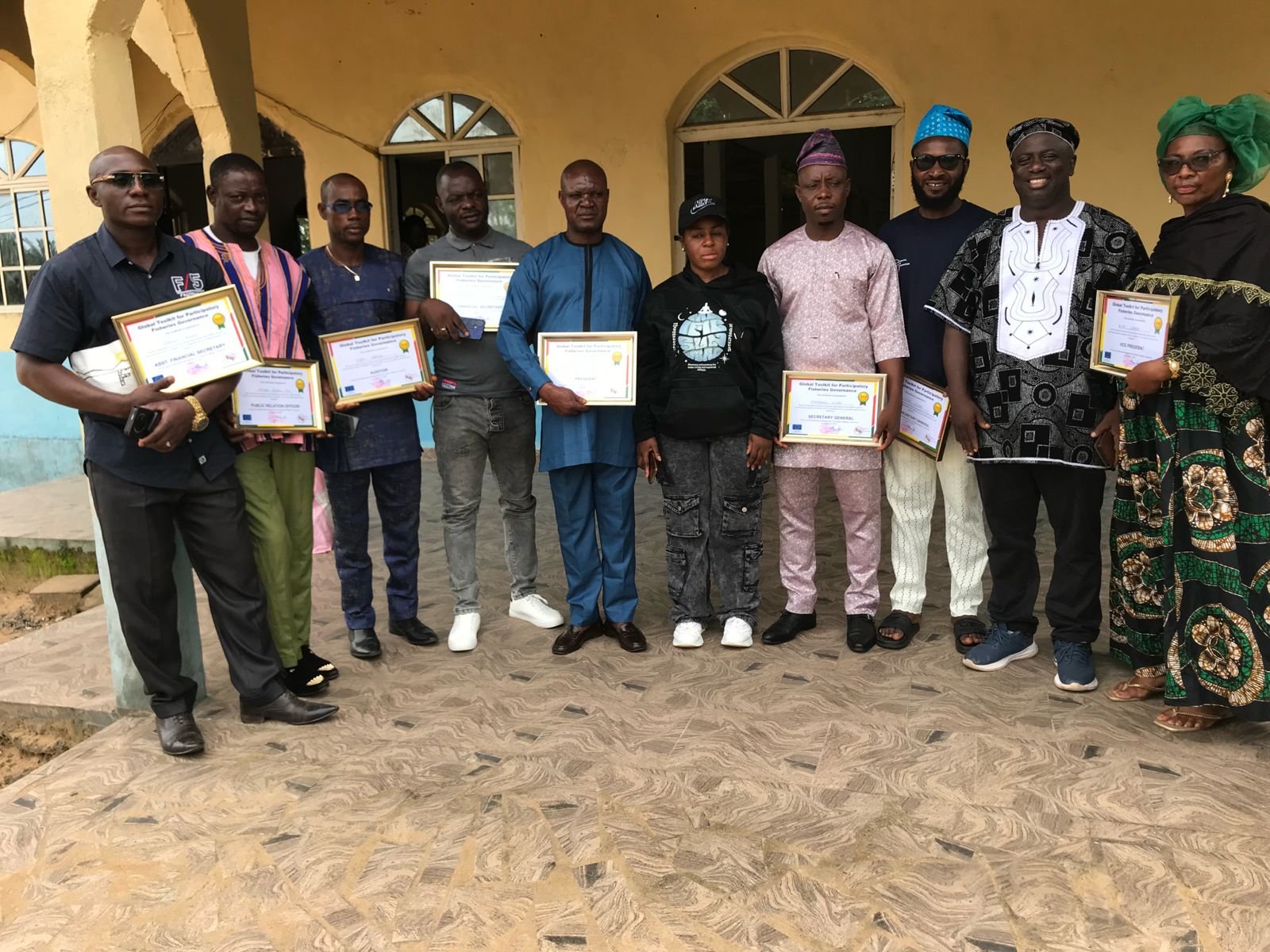
It was not a Sunday, but Cameroonians, Nigerians, Ghanaians, Beninians, and others who make up the fishing community all gathered in their church in Mbiako and later Yoyo I to witness their representatives installed. The pastors offered the opening prayers to implore the blessings of God on the members of the LCMC, who were installed by the Divisional Officer, Roland Ngah Koa. The 10-man committee includes two Cameroonians, two Nigerians, two Ghanaians, two women, chiefs, and youths, elected for a five-year mandate renewable once.

Their task is to mobilize community members, target groups, and indigenous peoples to draw up and implement management plans; sensitize and educate community members on the management of a Protected Area and its Outstanding Universal Values (OUVs); share information on decisions taken by the administration; collect and communicate any grievances, illegal exploitation of timber and NTFPs, poaching, or inadequate hunting practices; and maintain and participate in the surveillance of PA boundaries, among other things.
“I will collaborate with the government to seek a solution to the trawlers phenomenon. I suggest the army should be removed from the trawlers”, says Mbianko, LCMC President. Magmaen Loius Fils, LCMC president of Yoyo, shares the same view; besides, he and his team would continue sensitizing the community to understand the importance of conservation, with fishing central to their daily existence. Magnaen says, “The collaboration should be frank. With the contribution of NGOs and the government, there would be a change, especially regarding the trawler phenomenon,” he says.
Guidance from traditional rulers is crucial for members of the LCMC. His Majesty Ebenezer Tonga Ngando, Chief of Yoyo II, says, “Mangrove wood is used to dry fish, and over-harvesting can destroy the ecosystem that serves as a breeding space for fish; if destroyed, there can be no fish,” underscoring the importance of the LCMC in contributing to mangrove conservation.
Mvondo Kenneth, the conservator of Douala-Edea National Park, praised the establishment of the LCMC, which aligns with government policy, through the guide for the local communities, allowing for the inclusion of those who rely on hunting and fishing inside the protected area.
“The newly installed committee has the total support of the conservation officer to guarantee sustainable forest and sea management. To conserve and manage resources effectively, the committee will be at the forefront of conservation services.” Mvondo claims that the conservation services by themselves are unable to safeguard the national park.
Assuring the conservation is ready to work with the LCMC, Roland Ngah Koa, the Divisional Officer for Mouanko, cautioned the committee members to collaborate with local authorities to manage resources. “This committee is not a decision-making body. “The authorities are aware of the Chinese trawlers and would take appropriate measures,” he says.
IUU Fish remains a Challenge
In the settlements along Douala-Edea National Park—Mbiako, Yoyo I, and Yoyo II—fishers constantly fear “Sapak,” or Chinese trawlers. One of Cameroon’s 22 national parks is Douala-Edea, a first-class park covering over 2630 hectares of land and sea. IUU fishing, the use of chemicals like gamaline to fish, undersized nets, improper fishing methods, and overexploitation of mangroves are among the issues undermining conservation efforts of the park.
“The trawlers’ army pursues us with guns at sea; occasionally, they spot us and purposefully destroy and cut our nets with the catch.” They shoot if we chase them to retrieve the nets. Three fishermen were shot last year, according to a fisherman in Mbiako, an island in the Mouanko subdivision of the Sanaga Maritime Division of the Cameroonian coastal region.

Peter Adebanwu, a 23-year-old fisherman from Yoyo II, another fishing community, narrates the same ordeal with the trawlers, and adds, “The trawlers equally take our fishing kit, which they cut and sell in Douala.”
The financial burden on the fishers who have to replace their nets destroyed by trawlers is huge. Fumelayo Eneola in Mbiako explains how indebted the fishermen have become as they borrow to buy new fishing kits. “Our husbands (fishermen) are entangled in a spiral of debt as they borrow from market women to buy the kits which the trawlers destroy often.”
The fishing communities have complained to the authorities of the Ministry of Livestock, Fisheries and Animal Industries through an official they call ‘Doctor Fish’ and at the regional office in Douala, but there has been no solution. The impact of the trawlers is huge on the fishers, their families, the economy, and biodiversity, as captured by the Environmental Justice Foundation EJF report.
According to its IUU legislation, Cameroon’s illegal, unreported, and unregulated (IUU) activities forced the European Union (EU) to issue a “red card,” which prevented Cameroonian fisheries products from entering the EU. However, there is hope as Fayiah says communities would use EJF’s Dase app to document illegal fishing. Fishermen capture trawlers with the vessel names with georeferencing and send them to the database for analysis.