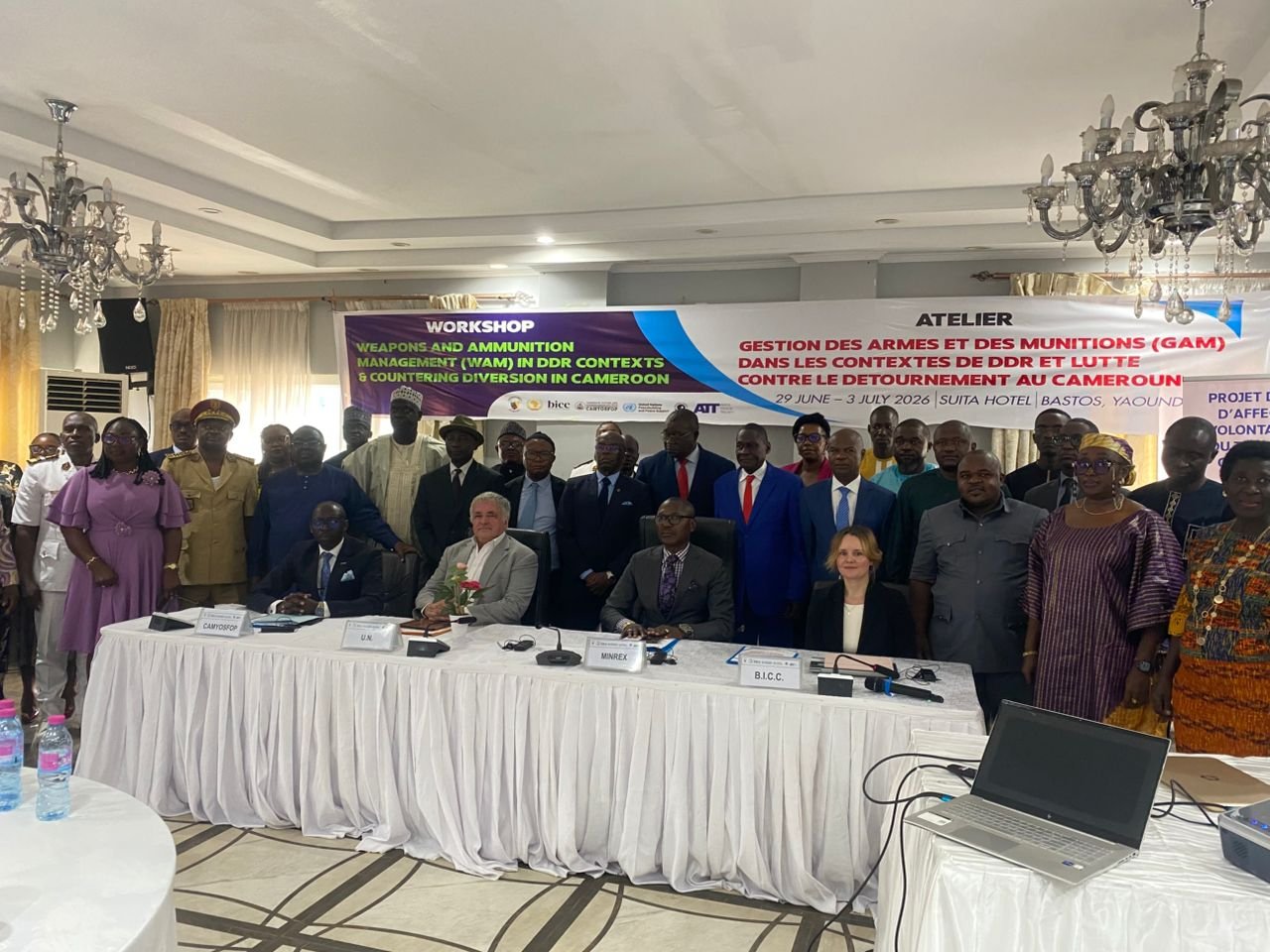
Cameroon has stepped up efforts to curb the circulation of illicit arms and ammunition amid ongoing conflicts in parts of the country by launching a five-day integrated training workshop on weapons and ammunition management in conflict situations.
The workshop, which officially opened at Suita Hotel in Bastos, Yaounde, on Monday, June 29, is organised by the Ministry of External Relations (MINREX) in collaboration with the Cameroon Youth and Students Forum for Peace (CAMYOSFOP), the Bonn International Centre for Conflict Studies (BICC) and other partners, with support from the Arms Trade Treaty Voluntary Trust Fund (VTF) and the German Government.
The training aims to strengthen the technical and strategic capacities of members of the National Disarmament, Demobilisation and Reintegration (DDR) Committee, relevant ministries and institutions, and civil society organisations in the secure management of weapons and ammunition, preventing diversion, and ensuring compliance with the Arms Trade Treaty (ATT) and other national and international arms control instruments.

Launching the seminar on behalf of the Minister of External Relations, Dr Basile Kemogne, Inspector General at MINREX, expressed the government’s appreciation to the United Nations (UN) for its continued support to Cameroon.
“The United Nations has kindly chosen to assist us through the mechanisms they have put in place for the collection and destruction of weapons, and to ensure that the weapons circulating on our territory are solely those managed by the security and defence forces,” he said.
While commending Cameroon for the progress made so far, the UN representative, Sergiusz Sidorowicz, reaffirmed the organisation’s commitment to supporting the country’s arms control efforts, noting that the UN has worked alongside Cameroon since the creation of the National DDR Committee.
“We will see during the training whether there is any further need for assistance, and that assistance can take multiple forms,” he said.
He added that the UN could support the development of legal and policy frameworks as well as provide additional training for specialised agencies.
Sidorowicz also underscored the importance of public awareness, stressing that effective weapons and ammunition management requires the participation of the wider community.
“There is a role for society in weapons and ammunition management, not just the government. It is everyone’s responsibility,” he said.
For his part, CAMYOSFOP Executive Director, Ngalim Eugine Nyuydine, said the training would also focus on the regulation of international arms transfers and the protection of human rights.
“We shall also be examining the Arms Trade Treaty, which regulates the sale of weapons and addresses issues such as diversion, gender-based violence and violations of international humanitarian law,” he explained.
The seminar will conclude on Friday, July 3, with a policy conference at the International Relations Institute of Cameroon (IRIC).