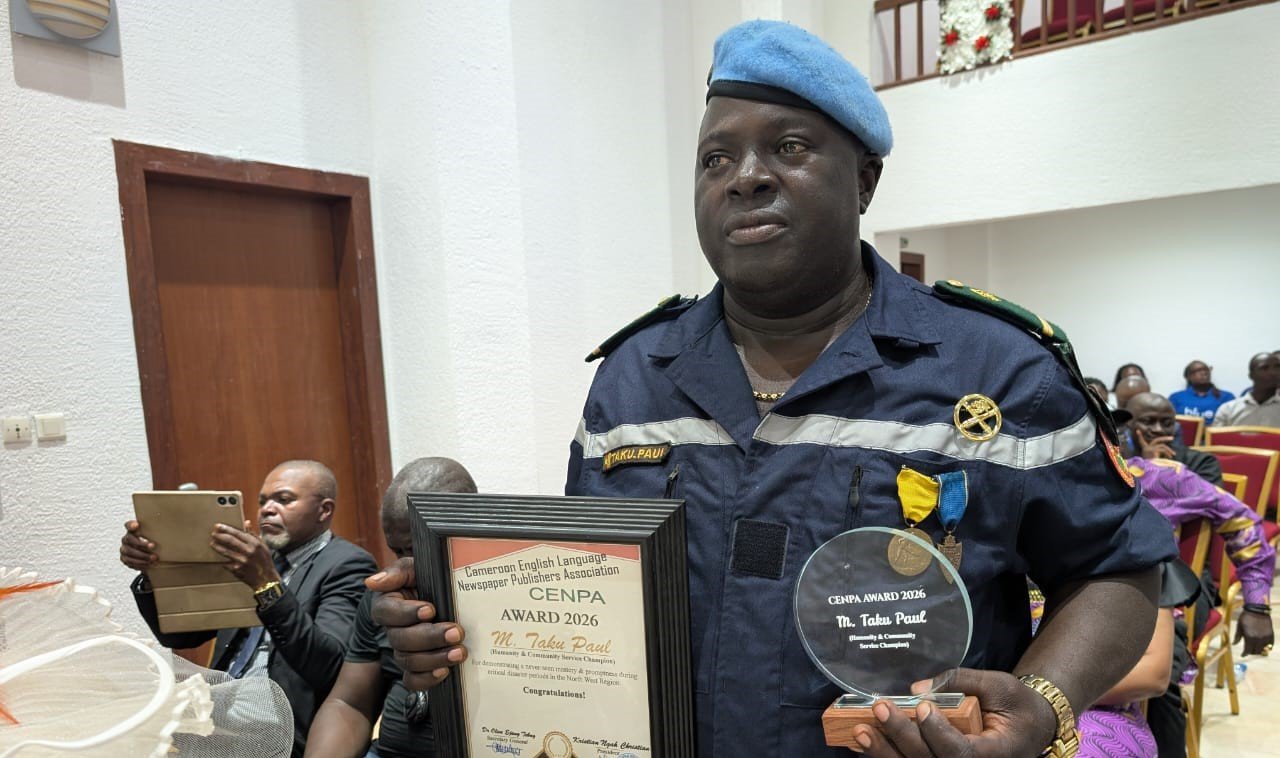
For nearly a decade, Senior Warrant Officer Taku Paul, Chief of Centre of the Army Rescue Unit in Bamenda, has occupied an unusual frontline position in the crisis-hit North West Regional capital, frequently leading his team into some of the city’s most dangerous civilian emergencies.
Since 2018, Taku has led firefighters and rescuers into burning markets, schools, vehicles and commercial establishments. He has also been at the forefront of searches for people swept away by floods or drowned in waterways, as well as recovery operations following fatal accidents.
His efforts have not gone unnoticed.

The Cameroon English Language Newspaper Publishers Association (CENPA) has recognised the hardworking officer, naming him winner of its 2026 “Humanity and Community Service Champion,” Award with the jury citing his “mastery and promptness during critical disaster periods in the North West Region.”
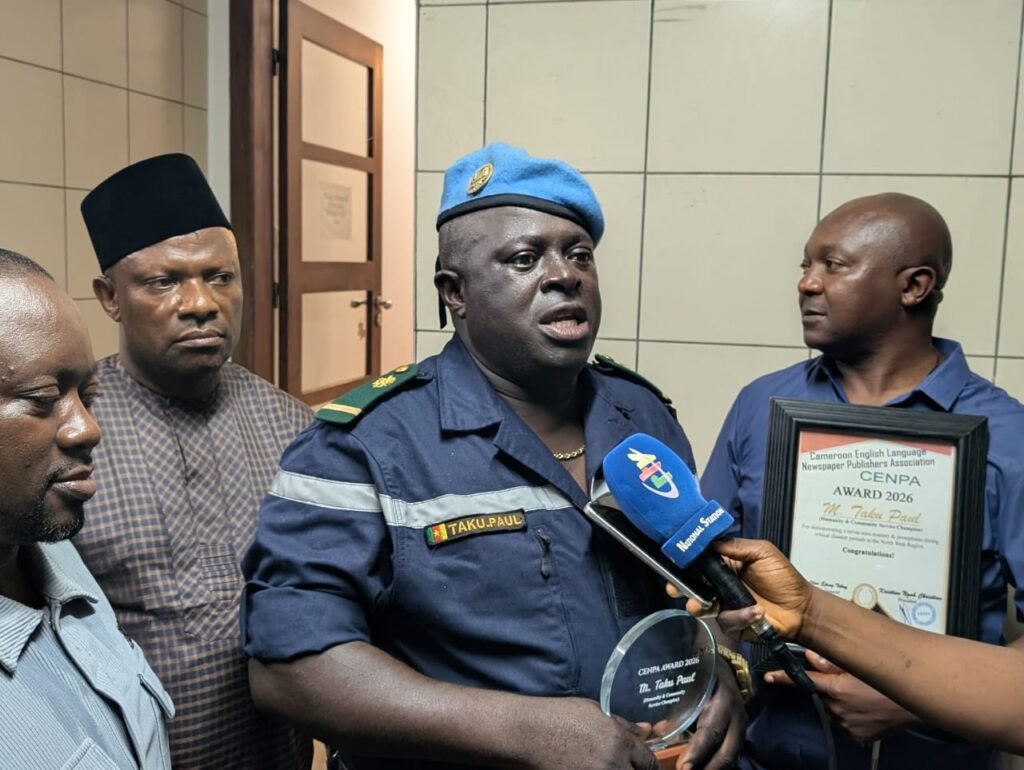
“Though the award carries my name, it is for the work my colleagues and I do as a team. Knowing that people watch us and honour us like this is a great mark of encouragement. I am very happy, and this award can only push me and my colleagues to do more for the population of Bamenda,” Taku Paul told NewsWatch after receiving the award.
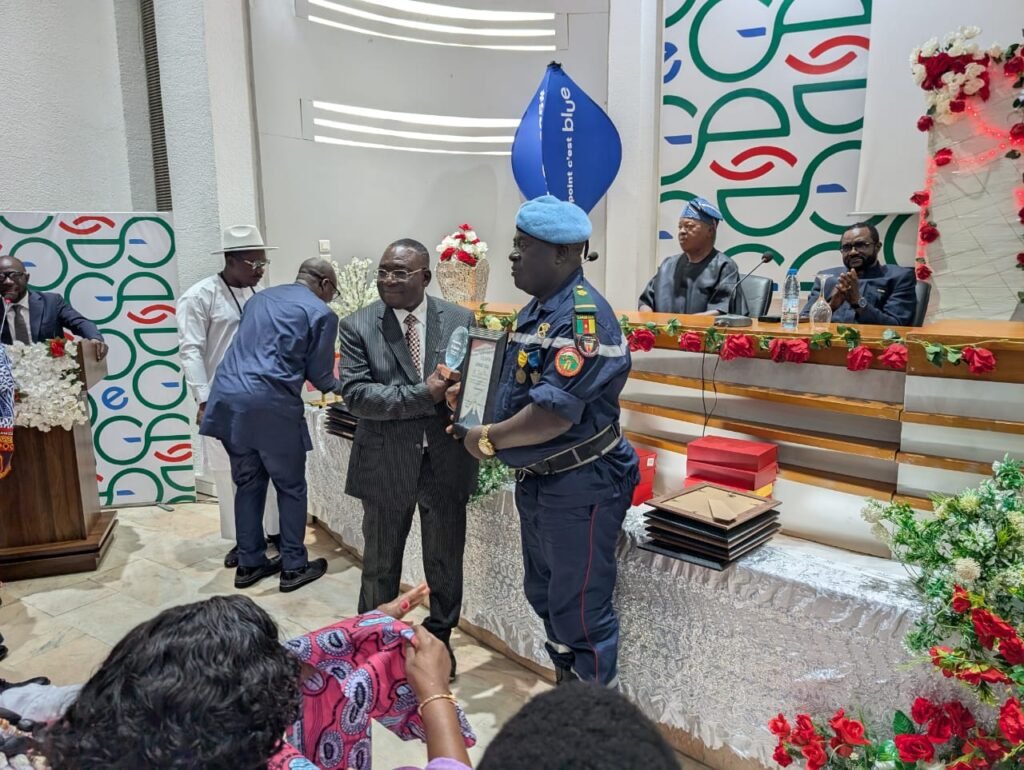
Taku was among more than 50 Cameroonian personalities from governance, media, business, humanitarian work and health recognised during the third edition of the CENPA Awards for their contributions to national development.
The CENPA Awards Night, held at the André Siaka Hall of the Union of Cameroon Enterprises (GECAM) in Bonanjo, Douala, was chaired by legal luminary and peace advocate Ntumfor Barrister Nico Halle, who praised the integrity of the award process and CENPA’s choice of recipients.
For Taku Paul, the recognition comes after years in which he and his colleagues have repeatedly found themselves at the centre of emergencies affecting ordinary residents across the conflict-hit North West Region.
He thanked the population of Bamenda for their cooperation in providing the Army Rescue with accurate information about incidents requiring intervention, saying such collaboration has helped facilitate timely responses.
According to Taku, the Army Rescue’s humanitarian missions include responding to structural fires and industrial explosions, clearing debris from collapsed infrastructure, assisting people involved in accidents, transporting sick persons to hospitals and helping pregnant women in need of emergency transportation.
“Yes, there is insecurity in some quarters in Bamenda, but the population knows that Army Rescue is a humanitarian service. That is why we go to every neighbourhood. We need to save lives,” he said.
In 2026 alone, Taku Paul and his colleagues have received praise for several high-risk interventions across Bamenda.
Among them was the Mile Two Bridge flood disaster in March, where rescue teams searched for people swept away by floodwaters. The same month, his unit responded to a dormitory fire at All Saints Catholic Comprehensive College at about 2:20 a.m., helping students to safety and containing the blaze.
Following the incident, Taku urged schools, markets and churches to install fire extinguishers and train staff in their proper use.
More recently, Taku and his colleagues led the search and recovery operation for two children swept away by floodwaters. His team also intervened at an accident scene at Veterinary Junction, where they controlled the crowd, recovered the body of a woman killed in the accident and helped prevent further disruption at the scene.
Another recent intervention came during a separatist-imposed lockdown aimed at preventing the resumption of schools earlier this month. Taku said his team transported more than 35 people to hospital free of charge after receiving emergency calls.
“During the lockdown period, we transported over 35 people to the hospital with our ambulances free of charge, following calls we received,” he said.
Despite the recognition, Taku said operational challenges continue to affect the work of the Army Rescue Unit.
He cited ongoing construction in Bamenda, which has narrowed some roads and left electricity cables hanging at low heights. According to him, rescue teams sometimes have to stop and manually adjust or clear obstacles before fire trucks can pass.
He also said construction-related damage to telecommunications cables has occasionally disrupted the toll-free emergency number, 118.
“That is why I also give out my personal phone number for the population to call directly if they cannot reach us through the toll-free number,” Taku said, while praising Bamenda residents for their continued cooperation.
This report was first published in NewsWatch Newspaper No. 239 of Wednesday, September 23, 2026.